See how Smart, Strict, and Alert decisions combine rules, source/IL structure, and AI to detect modern .NET/ASP.NET web shells, including obfuscated loaders, archives, and managed DLLs.
Not rated yet
DNN Defender does not decide that a file is malicious from one filename or one keyword. It routes
the artifact by type, evaluates independent engines, and records enough evidence for an operator
to understand the final result.
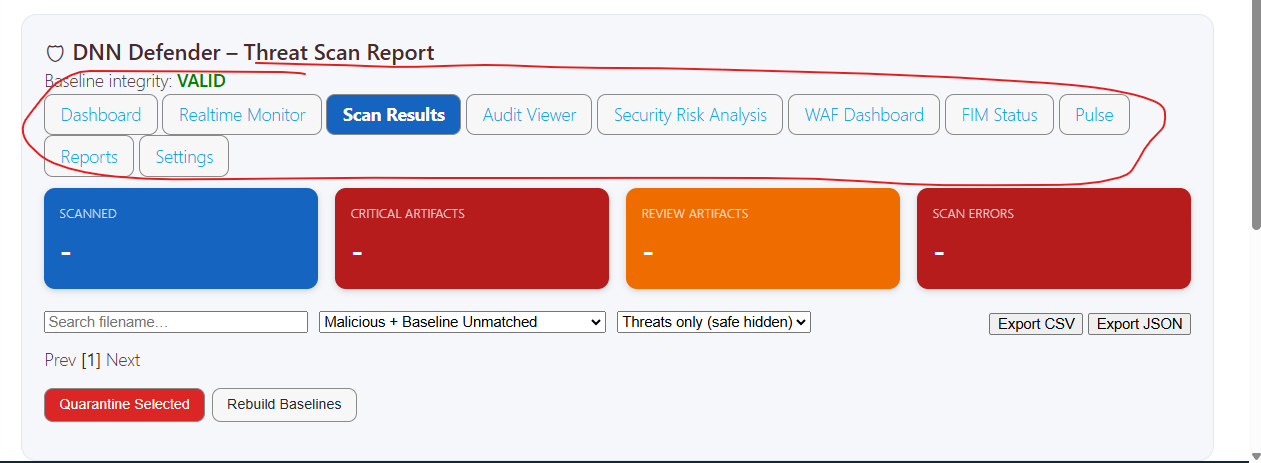 Actual module screen: Scan Results separates scanned artifacts, confirmed threats, review items, and genuine scan errors. Counts and control state vary by site, edition, and build.
The engine is validated against a controlled malicious-sample corpus and specialized .NET/ASP.NET
honeypot intelligence. The current corpus includes compact one-line loaders, ASPXSpy/WSO-style
shells, request-driven command execution, reflection and in-memory assembly loading, encoded or
encrypted remote payloads, file managers/uploaders, process and PowerShell launch chains,
post-exploitation helpers, malicious archive members, and suspicious managed assemblies. Every
web-shell family represented in the current validation corpus is expected to produce a malicious
or review decision rather than silently returning SAFE.
Smart, Strict, and Alert decisions
- Smart correlates weak signals into behavior: attacker-controlled input, decode/decrypt,
dynamic load or process execution, filesystem manipulation, persistence, and command output.
Benign reflection or a generic token alone is not enough.
- Strict enforces high-confidence rules and protection policy. A confirmed executable payload
can be blocked or quarantined without waiting for the AI layer.
- Alert/Review retains anomalous or incomplete chains for investigation instead of forcing a
false
Clean verdict. This is important for new, damaged, encrypted, or deliberately minimal
samples.
Sensitivity, false positives, and known-good files
DNN Defender is intentionally sensitive to combinations frequently used by attackers: dynamic
loading, reflection, decoding, process execution, command input, file manipulation, outbound
connections, persistence, and executable content in upload locations. A legitimate administration
tool, installer, diagnostic component, or custom module can occasionally use a similar primitive.
That trade-off can produce a false positive or, more commonly, a Review Required result. It is
preferable to expose an unusual executable artifact for review rather than silently label an
unknown implant SAFE.
A reviewed file may be accepted as known-good and added to the baseline, but only after the
administrator verifies:
- the file came from an approved vendor or internal build and the package/hash is authentic;
- its path, deployment time, signer/version, and business purpose match the approved change;
- its code or IL behavior explains the detected signals and contains no attacker-controlled
execution chain;
- related files, privileged accounts, scheduled jobs, WAF events, and FIM changes show no incident
context; and
- the exact accepted file hash is recorded with reviewer, reason, and approval time.
Baseline acceptance means this exact reviewed state is trusted. It must not disable the rule
globally, allow every file in the folder, or convert future changed hashes into SAFE. If the file
changes later, Realtime Monitor, the scanner, and FIM must evaluate it again. Never baseline an
artifact merely to make a Critical/Review count disappear.
The three layers
- Rule Engine identifies high-confidence behavior chains and known dangerous combinations.
A single generic token such as
reflection, location, or an IP-like string is not sufficient
for a blocking rule.
- AST/structural analysis examines executable source structure. It is applicable to supported
text-based server code, not arbitrary binary bytes.
- AI/semantic model supplies an independent score when the licensed model is available. Its
output never changes a clean engine label into a false statement; unavailable or failed engines
are shown explicitly.
The scanner loads its packaged ML.NET model from the site's filesystem and runs inference locally
in the IIS application process. The file-scanning prediction path does not call a cloud analysis
service. Administrators should still review separate email, support, and integration settings
before exporting any evidence. A reproducible public false-positive/false-negative benchmark has
not yet been published; no percentage should be inferred from the model score. The report names
which engine supplied each verdict and shows an unavailable engine as unavailable, not Clean.
The AI layer is intentionally probabilistic. Instead of requiring an exact hash or identical text,
it scores a broad combination of weak or ambiguous features—sometimes described operationally as
“fuzzy” evidence. A renamed, reordered, string-split, or partially obfuscated variant can therefore
remain similar to malicious behavior even when no single literal signature matches. This is
probability/semantic scoring, not a claim that one AI score is sufficient for every blocking
decision.
Rules and AST/IL analysis attack the problem from the opposite direction: they follow execution
primitives that ASP.NET malware must eventually use to achieve its objective. Classic and modern
web shells may change names, encoding, comments, control flow, or delivery format, but useful
attacker behavior still needs one or more of these steps:
- accept attacker-controlled request, cookie, header, file, or command input;
- decode, decrypt, decompress, or reconstruct the payload;
- dynamically compile, resolve, load, or invoke code through reflection or assembly APIs;
- launch a process, command interpreter, PowerShell, unmanaged bridge, or outbound callback;
- read, write, upload, replace, or enumerate files and configuration;
- return command output, maintain a session, or establish persistence.
Rule correlation detects the dangerous chain; AST/IL analysis identifies the actual call structure
even when superficial text has been changed; AI recognizes related combinations that do not fit an
exact known rule. An attacker must remove the behavior needed to operate the shell—not merely rename
the code—to evade all three layers at once.
Engine labels mean exactly: Blocked/Malicious, Review Required, Clean, or Engine
Error. The final action, confidence, overall risk, and individual engine verdicts must agree.
Fast response to a new attack family
Detection is not frozen into one compiled signature list. New honeypot or incident evidence can be
converted into a bounded rule, structural behavior pattern, advisory mapping, or updated semantic
model and delivered in a signed rule/knowledge or module release. Regression samples are retained
so improving detection for a new family does not silently break previously working detections or
reintroduce broad binary/text false positives.
For a previously unpublished vulnerability, the exploit may have no CVE-specific rule on day one,
but its payload and persistence behavior still has to cross the generic upload, executable-content,
source/IL analysis, realtime, FIM, quarantine, and audit controls. This gives the defender both
preventive opportunities and multiple independent chances to expose the intrusion.
Full scan and realtime are different clocks
The full scan checks existing eligible files in the background. Realtime Monitor reacts to later
filesystem changes. Neither clock proves that a newly written shell could not execute before the
watcher and scanner finish. Where a request path is known, Prevention/Strict is the request-time
control. See Performance on shared hosting and dedicated IIS for scan pacing, backlog, and operational limits.
Archives
ZIP-like containers are opened recursively within safety limits so an ASPX, ASHX, DLL, PHP, or
other executable payload cannot hide behind the archive extension. Investigation rows can show
each malicious inner entry as archive.zip!/path/file.aspx, while dashboard KPIs count the
physical archive once. This prevents a sample pack with hundreds of payloads from distorting site
health.
JSON, RESX, XML/resource metadata, model data, ordinary JavaScript, and source maps are skipped by
the server-side web-shell pipeline. An intentional skip is normal control flow and is not stored as
SCAN ERROR. Password failures, archive limits, read failures, or unavailable engines remain
visible as genuine errors.
Managed DLLs
DLLs are never decoded as UTF-8 and matched as source text. Managed assemblies are inspected with
the packaged metadata/IL reader without loading or executing the assembly. The report identifies
the assembly, method, call-site, and correlated APIs when relevant. Native PE files require
provenance, signature, hash-reputation, or a dedicated native-code engine; they are not promoted to
malicious from raw binary text.
Obfuscated reflection loaders
For ASP.NET source, the detection-only canonical view decodes Unicode escapes, normalizes C#
verbatim identifiers such as @System.@Reflection.@Assembly, and removes ignorable comments and
whitespace. A high-confidence reflection-loader decision still requires a complete behavior chain:
request-controlled input, decode/decrypt, assembly resolution and load, then dynamic invocation.
Reflection metadata alone is not malicious.
Reading Scan Results
- Keep Threats only selected for daily triage; safe results are hidden unless explicitly shown.
- Filter by action, confidence, engine, path, or time before exporting.
- Treat a server-executable file newly found under
Portals as urgent even when it is Review
rather than a confirmed rule block.
- Use Create Baseline only after independent verification. Do not use it as an alert-dismissal
shortcut.
- Quarantine only after confirming the path, evidence, and business impact.